Towards a holistic non-financial performance measurement for Istibdal Waqf Projects in Malaysia
Pengukuran prestasi bukan kewangan yang holistik bagi Projek Istibdal Wakaf di Malaysia
DOI:
https://doi.org/10.53840/almimbar.151الكلمات المفتاحية:
Istibdal Waqf، Non-Financial Performance Measurement، Waqf Institutions، Malaysiaالملخص
ABSTRACT
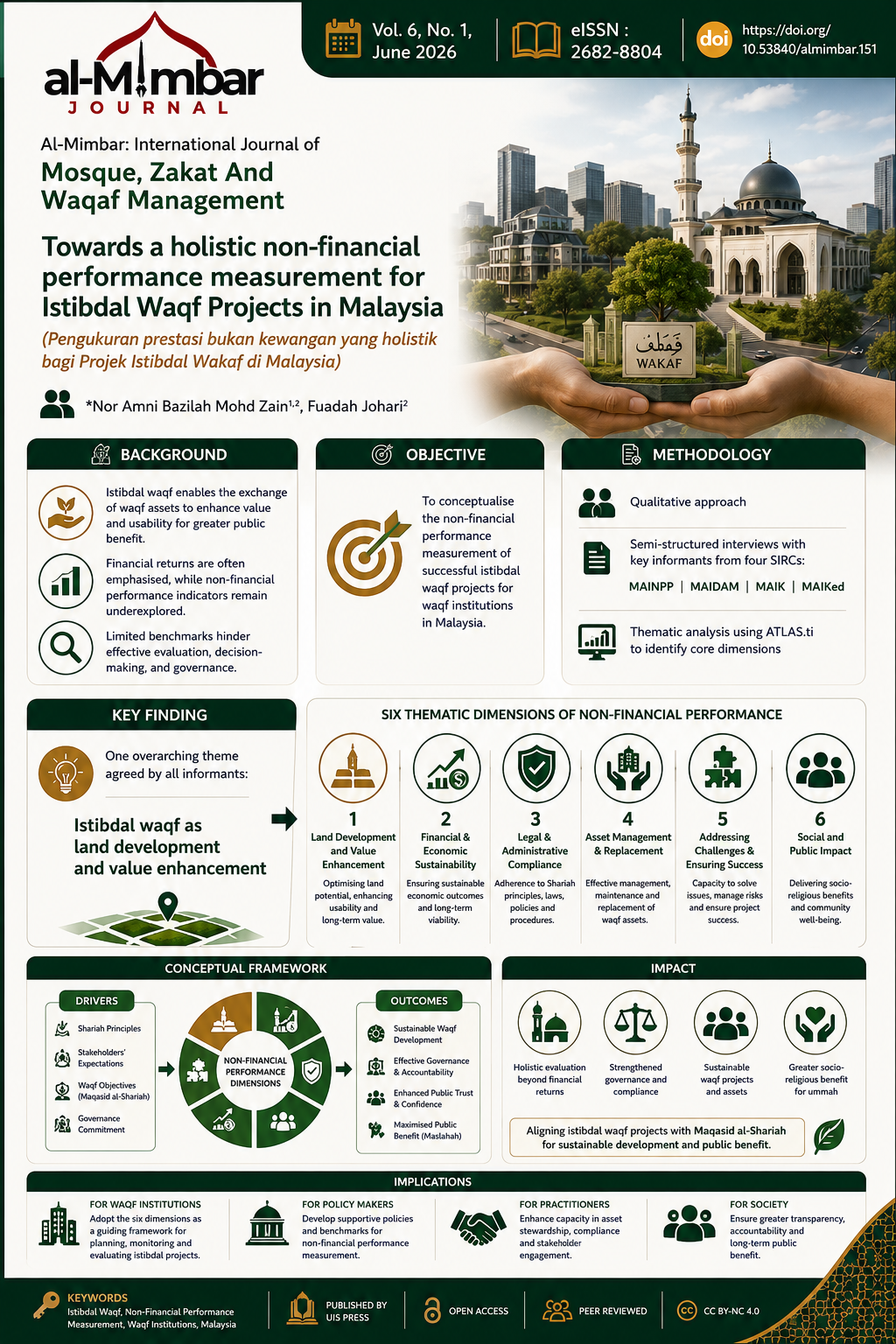
Istibdal waqf, a mechanism for replacing or exchanging waqf assets to enhance value and usability, plays a significant role in sustaining waqf development in Malaysia. While financial performance indicators are often emphasised, non-financial performance indicators remain unexplored, despite their critical contribution to long-term success. This study aims to conceptualise the non-financial performance measurement of successful istibdal waqf projects for waqf institutions in Malaysia. The research addresses the problem of limited performance benchmarks in evaluating istibdal waqf projects, which hinders effective decision-making and governance. In Malaysia, only some State Islamic Religious Councils (SIRC) actively implement such projects, reflecting the need for a more comprehensive performance assessment framework that transcends monetary returns. A qualitative approach was employed, involving semi-structured interviews with key informants from four state Islamic religious councils: Majlis Agama Islam Negeri Pulau Pinang (MAINPP), Majlis Agama Islam dan Adat Melayu Terengganu (MAIDAM), Majlis Agama Islam dan Adat Istiadat Melayu Kelantan (MAIK), and Majlis Agama Islam Negeri Kedah (MAIK). Thematic analysis using ATLAS.ti was applied to identify core dimensions. Findings reveal one overarching theme agreed upon by all informants: Istibdal waqf as land development and value enhancement. From this, six thematic dimensions of non-financial performance were conceptualised: (1) Land Development and Value Enhancement; (2) Financial & Economic Sustainability; (3) Legal & Administrative Compliance; (4) Asset Management & Replacement; (5) Addressing Challenges & Ensuring Success; and (6) Social and Public Impact. These dimensions highlight that success extends beyond profit generation to include compliance, asset stewardship, problem-solving capacity, and socio-religious benefits. The study concludes that non-financial performance indicators are essential for a holistic evaluation of istibdal waqf projects, aligning with the Maqasid al-Shariah principles. It is recommended that waqf institutions adopt these dimensions as a guiding framework to ensure sustainable development, enhance governance, and maximise public benefit in future istibdal waqf initiatives.
Keywords: Istibdal Waqf, Non-Financial Performance Measurement, Waqf Institutions, Malaysia
المراجع
Al-Qardhawi, Yusuf. (1973). Fiqh al-Zakah: Dirosah Muqaranah Li Ahkamiha Wa Falsafatuha Fi Dhou’ Al-Quran Wa As-Sunnah. (2nd ed). Juz’1. Beirut: Mu’assasah al-Risalah.
Amin, H., Jam, N. S., & Ring, P. J. (2025). Examining cash waqf giving decisions in Malaysia. International Journal of Social Economics. https://doi.org/10.1108/IJSE-12-2023-0964
Anuar, N. A., Sulaiman, M. A., Mokhtar, N. N. A., Zainol, N. N., Isa, M., & Wan Zahari, W. Y. (2022). “Evaluating the Performance of Waqf Land Development: A Case Study of Waqf Seetee Aisah, Pulau Pinang”. Journal of Social Sciences and Humanities. Vol. 6. (1). pp. 109–121.
Arshad, R., Zain, N. M., Urus, S. T., & Chakir, A. (2018). “Modelling Maqasid Waqf Performance Measures in Waqf Institutions”. Global Journal Al-Thaqafah. Special Issue. pp. 157–169.
Asni, F., Mohammed Noor, A., & Hasbulah, M. H. (2024). Management of cash waqf fund generation through the implementation of istibdal in Kedah. Qualitative Research in Financial Markets, 16(1), 60–86. https://doi.org/10.1108/QRFM-03-2022-0048
Hatimah, H., Sukoharsono, E. G., Djamhuri, A., & Adib, N. (2024). Exploring Waqf Management Transformation: Opportunities and Challenges (Case Study in Ismuhu Yahya Foundation Pontianak). Journal of Ecohumanism, 3(8), 58–68. https://doi.org/10.62754/joe.v3i8.4712
Ibrahim, A., & Ibrahim, ’Adnin. (2018). “Pelaksanaan Istibdal Dan Pembangunan Tanah Wakaf di Perak”. Asian People Journal (APJ). Vol. 1. (2). pp. 287-297.
Kasmon, B., Ibrahim, S. S., Daud, D., Raja Hisham, R. R. I., & Prajanti, S. W. (2025). FinTech application in Islamic social finance in Asia region: a systematic literature review. International Journal of Ethics and Systems, 41(1), 213–237. https://doi.org/10.1108/IJOES-07-2023-0155
Melis, A., Qoyum, A., & Ardiansyah, M. (2025). Determinant Cash Waqf Payment Amongst Rural Society in Yogyakarta: Do Itsar and Culture Matters?. Nurani, 25(1), 52–68. https://doi.org/10.19109/nurani.v25i1.26225
Mohd Thas Thaker, M. A. Bin, & Allah Pitchay, A. (2018). “Developing waqf land through crowdfunding-waqf model (CWM): the case of Malaysia”. Journal of Islamic Accounting and Business Research, Vol. 9. (3). pp. 448–456.
Mujahidin, M., Imran, M., Sapa, N. B., Fasiha, A., & Aisya, S. (2025). Challenges in Waqf Management and Its Implications for the Social and Economic Welfare of Muslim Communities: A Cross-Country Comparative Analysis. Jurnal Ilmiah Mizani, 12(1), 168–184. https://doi.org/10.29300/mzn.v12i1.7765
Musthafa, L. B., & Abdullah, N. B. P. (2022). The Reasons for the Permission of Replacement of Wakaf Assets (Istibdâl Waqf) in Indonesian Regulations: An Interpretative Study. Al-'Adalah, 19(2), 373–400. https://doi.org/10.24042/adalah.v19i2.14423
Nurjanah, N., Rahmatsyah, A., & Mutakin, A. (2022). Fatwa Lajnah Bahtsul Masail NU Concerning Istibdâl Wakaf and Their Relevance with Renewal of Islamic Law. Al-Istinbath: Jurnal Hukum Islam, 7(2), 509–530. https://doi.org/10.29240/jhi.v7i2.3707
Nurjanah, N., Rahmatsyah, A., & Mutakin, A. (2022). Fatwa Lajnah Bahtsul Masail NU Concerning Istibdâl Wakaf and Their Relevance with Renewal of Islamic Law. Al-Istinbath: Jurnal Hukum Islam, 7(2), 509–530. https://doi.org/10.29240/jhi.v7i2.3707
Pirmani, U., Kurniawan, E., & Najmi. (2024). From the Debate on the Legality of Waqf al-Ahl? to its Implementation in Southeast Asia: Indonesia, Malaysia, and Singapore. International Journal of Law and Society, 3(2), 59–76. https://doi.org/10.59683/ijls.v3i2.81
Wahyudi, H., Wisandani, I., Saputra, C., Lestari, W. R., & Leny, S. M. (2025). Digitalisation of Islamic Finance in the Era of Industrial Revolution 5.0: The Contribution of Crowdfunding and e-Wakaf to Islamic Fintech. International Journal of Economics and Financial Issues, 15(2), 46–53. https://doi.org/10.32479/ijefi.17480
Wan Nazjmi Mohamed Fisol, Abu Bakar, M., & Ahmad, A. (2021). Waqf property management through the Maqasid al-Shariah approach. Journal of Contemporary Issues in Business and Government, 27(3), 28–31. https://doi.org/10.47750/cibg.2021.27.03.004
Yumna, A., Marta, J., & Yanuarta RE, R. (2025). The impact of financial and social inclusion on well-being: evidence from a Waqf-based microfinance institution in Indonesia. International Journal of Ethics and Systems. https://doi.org/10.1108/IJOES-08-2024-0243
التنزيلات
منشور
إصدار
القسم
كيفية الاقتباس